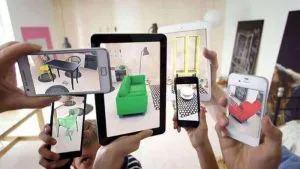
Augmented reality in eCommerce soon will revolt way we shop in the web. The growth of consumers’ demands an evolution of mobile devices and market capabilities lead to strong trends that make AR one of the major tools and platforms in the tech world.
- Magic Leap has got from Google $800 million alone and 1.4 billion from others.
- Apple has bought Metaio.
- Facebook advanced Oculus which has cost them almost $2 billion.
- Alibaba also announced that they are working on creating the Virtual and Augmented Reality services for e-commerce.
- Other major players like Microsoft, HTC/Valve, Sony, Samsung have their own projects.
All of that makes AR slowly capturing the interest of consumers and takes over mobile devices by creating a connection between the real and digital world. Meantime e-commerce companies may take their own role in all of this and rise up on a tide of new techs, like Amazon using internet overgrown Walmart 20 years ago.
Key Trends In eCommerce
For last year online shopping market has reached the highest number of sales via smartphones and tablets. And there is no doubt that the trend would only grow by the time. Past 2016 should be called as a year of e-commerce domination. One of the worldwide biggest retail brand Walmart announced that they have included in their plans to fund $2 billion to develop own online store. Amazon meantime overpowered valuation of Walmart. It has increased up to 42% sales of packaged goods to customers.
But for e-commerce, there are still other heavy challenges that should be solved. One of them is the conversions rate. Traditionally it stays low in the range of 2%-4%, while traditional brick-and-mortar conversions vary in 20%-40% range. E-commerce loses to retailers in sensory limits. As customers come to store they want to try by themselves everything they want before making decisions to purchase.
54% of customers prefer visiting stores because they can’t fully visualize products in online stores.
Nowadays e-commerce proposes good solutions to manage with that problem, Augmented Reality (AR) is among the top ones. As mobile devices change the landscape of e-commerce market (eCommerce has reported about up to 34% of all deals in online shopping by 2016 and its growth up to $626 billion in 2025), augmented reality soon should change the way we shop.
Customers expectations
- 63% of customers are sure that augmented reality may buff their shopping experience.
- 35% says that they would likely go shopping online more if there would be a possibility to virtually try stuff before buying it.
- 22% would be less likely to visit traditional retail stores if AR would be available in online stores.
There is no doubt that AR soon stops being a novelty and will become a common tool for day-to-day activities, like smartphones, tablets, and drones. According to some researches, it will already become true in 5 years. $2 of each $10 spent in e-commerce sales (not including in-app purchase) would be thanks for using AR.
So e-commerce giants like Amazon, eBay, and Alibaba, in pair with a pack of new players plan to start selling goods that new way. Redistribution of the e-commerce market in their spheres is inevitable, as well as the growth of eCommerce’s market itself.
Psychological aspects of AR marketing
Recently there has been an experiment conducted by Hidden Creative (UK) where products were demonstrated in two different ways. 200 parents had to judge what type of display was more persuasive: a traditional advert for a child’s toy or its image as an interactive augmented reality experience. Research conclusion clearly shows that AR marketing campaigns strongly overwhelm traditional marketing.
With usual ads, 45% of parents wanted to purchase a toy, while 74% of AR users. After looking at traditional 2D printed display adverts most of the parents were ready to pay £5.99 for the toy. In the other hand parents that use AR apps say that preferably the cost is £7.99.
Researches provided 5 main psychological reasons why AR boosts sales:
- A higher sense of ownership. When consumers engage to interact with a digital model of the product they feel closer relations with it, that to 2D printed image. Afterward, they start to feel some ‘property’ to the item.
- Incredible storytelling. People like to become part of events with some stories or news. AR helps to change any aspect into a multimedia platform and get anybody interested in. You’ll be crazy about that! Examples: AR storybooks, AR real estate, AR furniture.
- Wonder. AR experiences are so charming and interesting, that you can’t help diving into everything so wonderful and unusual and get it real. A product that makes you feel happy, is a product worth to be bought!
- Factual judgment. Everybody tries to feel safe, so it’s crucial to use previous strategies in AR marketing. With the help of AR service all products that are going to be purchased are deprived of doubts of the customers as far as a 3D visualization is used for AND test.
- Social animals. Before choosing any product you can ask some reviews from those who have already bought it. Your mission is to consult other customers and make your own decision.
Benefits of Augmented Reality in eCommerce
All those statistics, researches, trends and prognoses are needed for just one reason: to understand that augmented reality technology is fully suitable for e-commerce. In other words, AR can increase sales! AR can propose various features that may buff e-commerce.
- Product modifications and previews
77% of customers prefer to use AR capabilities to preview product variations such as color or style differences. Most of the customers look for the widest assortment to make a choice between packs of goods. Before purchasing anything they choose all available color selections and modifications of the product.
- Explore looks and features
40% of customers consent to pay a higher price for any products they were allowed to preview by AR. The big weakness of online store its lack of visualization. Customers prefer purchasing those products which they have tried. Test drive of available cars in a salon is the best example of how trials support sales. AR provides customers with tips, extra information, animations and possibilities to interact, to show how complex products are. There is nothing special in case that consumers want to try things before buying them.
- Provide tactile feelings
AR technologies like haptic headsets allow customers to try virtual models, and those technologies are becoming affordable as time goes. There are reasons to believe that such kinds of things would become no more special than home PC or Mac, and going shopping online would become more natural and comfortable.
- Increase time spend in stores
The average time that new visitors spend on a site is 2 minutes 31 seconds while returning visitors mostly double time longer – 5 minutes 31 seconds. UK scientific research says that consumers are more likely to spend time while interacting, playing or trying out AR model of a product. And that time rises more than 5 times.
- Imitate real in-store experience
Depending on the up-to-date research, 61% of the customers prefer purchasing goods in online stores that provide AR features, than those without it. AR gives customers virtual in-store experience, starting from a common chat with advisors to dressing up clothes or footwear (Topshop and Converse AR techs). Also, any AR user may see 3D models of special furniture from any degree and even put anywhere inside his or her own house.
- Help selling globally
72% of vehicle dealers among the United Kingdom hope that AR features help them sell their products in the future. In close range, dealers expect to improve numbers of inventory in dealerships stores, while decreasing showroom numbers at the same time. But in the future, there is a big chance to provide people with visualization of vehicle samples outside the real store.
- Eliminate doubts, reduce the return rate
45% of customers said AR features save their time to make a decision. AR provides customers with the ability to observe 3D model of products in online shops, as well as customize it. A wider choice, as well as more options, give customers abilities to make wiser decisions and improve the purchasing rate.
Read more: 20 best AVR development companies
Real-world AR ecommerce case studies
Several major retailers have deployed AR with measurable results:
| Company | AR feature | Results |
|---|---|---|
| IKEA Place | 3D furniture placement in your room via smartphone camera | 35% fewer returns on AR-previewed items; 11M+ downloads |
| Sephora Virtual Artist | AR makeup try-on using facial recognition | 45% increase in conversion for AR-tried products |
| Warby Parker | Virtual glasses try-on with face mapping | Reduced showroom dependency; expanded online-first sales |
| Amazon | AR View for furniture, decor, electronics sizing | Integrated across 100K+ products; reduces “will it fit?” returns |
| L’Oréal | ModiFace AR hair color and makeup simulation | 3x higher conversion rate vs non-AR product pages |
How to implement AR in your ecommerce store
Getting started with AR is more accessible than ever. Here is a practical roadmap:
- Choose your AR type: marker-based (QR triggers), markerless (surface detection), or face-tracking (beauty/eyewear).
- Select an AR platform: Apple ARKit (iOS), Google ARCore (Android), 8th Wall (web-based, no app needed), or Shopify AR (built-in for Shopify stores).
- Create 3D assets: Convert product photos to 3D models using photogrammetry tools or hire a 3D artist. Formats: USDZ (iOS), GLB (Android/web).
- Integrate into your store: Shopify, WooCommerce, and Magento all support 3D/AR product viewers natively or via plugins.
- Measure impact: Track AR engagement rate, time-on-page, conversion lift, and return rate reduction.
Budget: A basic web AR experience starts at $5,000–$15,000. Full native app integration with custom 3D models ranges from $30,000 to $100,000+.
Challenges of AR in ecommerce
- 3D content creation cost — photorealistic 3D models require skilled artists or expensive scanning equipment.
- Device fragmentation — AR capabilities vary across phones. Older devices may not support ARCore/ARKit.
- User adoption — many shoppers still are not familiar with AR features. Clear CTAs and tutorials help.
- Performance — heavy 3D assets can slow page load. Optimize models and use progressive loading.
Frequently asked questions
Do customers actually use AR when shopping online?
Yes. According to Shopify data, products with 3D/AR content see a 94% higher conversion rate compared to products without it. Younger demographics (18-34) are the most active AR shoppers.
Can I add AR to my existing Shopify store?
Yes. Shopify natively supports 3D models in USDZ and GLB formats. Upload a 3D file to your product listing and AR view is automatically available on supported devices.