With the release of major VR headsets Virtual Reality’s potential in entertainment and science has been finally uncovered. And the labor behind hundreds of constantly emerging projects falls on shoulders of VR developer. This is a new breed of programmers of high demand. How to hire VR developer is a teaser that hasn’t been fully solved yet. But let’s try.
Skills
2026 XR Market Update
The VR market has evolved into the broader XR (Extended Reality) space. Apple Vision Pro (2024) validated spatial computing for enterprise. Meta Quest 3 leads consumer VR. Google Cardboard and Samsung Gear VR are obsolete — the market consolidated around Meta Quest, Apple Vision Pro, and PlayStation VR2. Key skills: Unity, Unreal Engine 5, visionOS, Meta Presence SDK, WebXR. Rates: $80-120/hr (Eastern Europe), $150-250/hr (US).
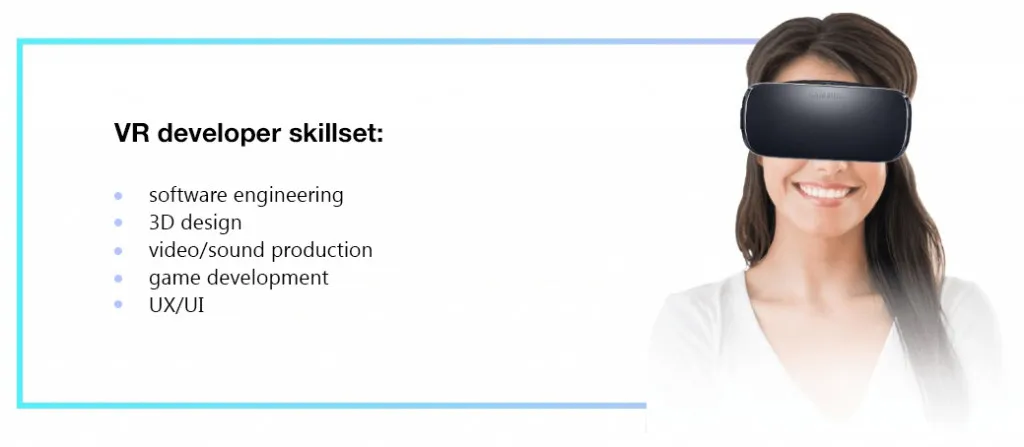
A good virtual reality developer has to possess a certain set skills. Entrepreneurs & businesses seeking to hire VR developer should find a combination of a) software programming, b) 3D design skills, c) video/sound production skills, d) game development, e) UI/UX. In other words, just being able to create 3D environments is not enough. VR developer often has to come up with brand new ideas.
Types of VR apps
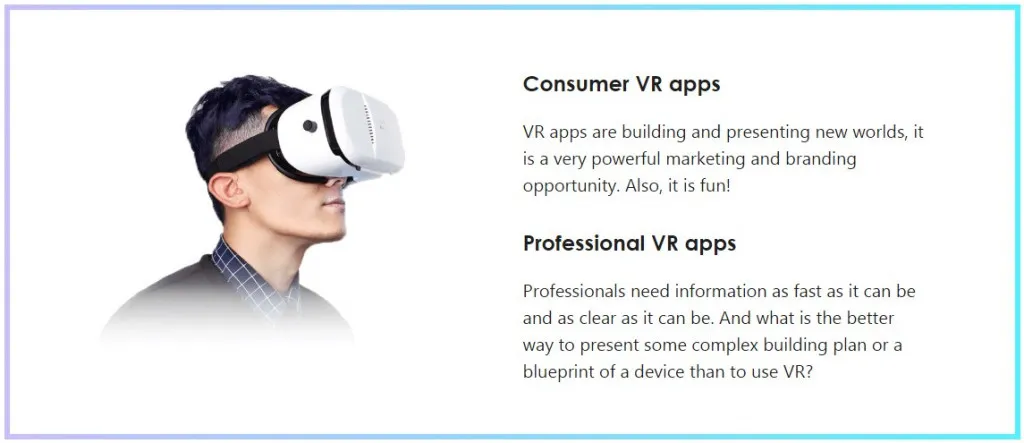
Virtual Reality apps grant extensive opportunities in any kind of industry there is. ThinkMobiles VR development team has already created apps for the following purposes:
- Virtual Reality training programs are changing the approach to educational process. Students can explore complex objects, like a human body in anatomy class.
- Merchants are eager to engage customers in any possible way, and VR is a brand new and popular tool right now, making products fascinating and desirable.
- Real Estate: to see what your home will look like, even before it is even built, or visit a property on sale without leaving home via stunning 360-degree virtual tours.
- With VR headsets people all around the world can take virtual tours to any country, visit museums, parks, or climb the highest mountain without any risks.
Benefits to hire a VR developer
Where to find
So you have an idea for a fantastic Virtual Reality app, now where can you find and hire VR developer? Basically, you have four directions to explore: developer communities, freelance sites, source code platforms, social media. For instance, official VR developer communities like Google VR developers, Oculus developer center, Vive/Steam developers, Gear VR developers, PlayStation VR developers, Unity3D community.
Basics on various VR developers
Hire a Google Cardboard
|
Google Cardboard caused a truly disruptive effect on VR industry. For developers it is a suitable platform to create VR apps and for Google cardboard app a VR developer would have to have skills in Java, Objective C, or C#, as well as native iOS, Android and hybrid apps development skills. |
|---|---|
| The Gear VR headset by Samsung works in a 96-degree field of view, using the Oculus platform, so if you’re looking to hire Gear VR developer, he/she should be familiar with Oculus mobile SDK at least. C, C++ and C# coders with skills in game engines like Unity, Vuforia or Unreal. |
Hire a Samsung Gear
|
Hire a PlayStation VR
|
PSVR is a more complicated and sophisticated piece of hardware designed for PlayStation 4 gaming console. Beside VR headset it also includes 2 motion controllers, eye tracker, headphones and accessories – the 100% game-oriented product, so a VR developer should be a game developer primarily. |
| SteamVR is for HTC Vive, Oculus Rift and Open VR. As the unique 360-VR experience requiring a separate interactive game room, a VR developer has to be a highly-skilled 3D game creator. SteamVR developers utilize Unreal and Unity engines, OpenVR SDK, Viveport SDKs, etc. |
Hire a SteamVR
|
Hire an Oculus VR
|
One of the most popular VR headsets with free development kits, Oculus presents plenty of possibilities for VR developers. To hire a VR developer implies knowledge of Oculus SDK and documentation, C++, Unity, Unreal, CryEngine skills, as well as a possession of latest DK-2. |
Cost & Rates
While you may find out more on VR application development cost, keep in mind that VR projects may range from $5,000 to $300,000 in cost, and last from few months to over a year. In terms of individual VR developer expenses, 2 key standpoints are hourly rates and salaries.
$50/hr – average rate
*starting from $25 and up to $130, depending on expertise
According to market researches, like the ones by Payscale and Neuvoo, median annual salary of today’s virtual reality developers is around $100K. Obviously, it may be less or more, depending on skills level, expertise and type of project.
- $70,000-80,000 Middle software developer, UX designer, animation designer, 360-degree video editor, user interface developer, etc.
- $130,000-180,000 Senior software developer, Virtual Reality developer, game engines expert, AR developer, senior 3D designer, etc.
ThinkMobiles VR development team can create:
You’ll receive you app on-time, according to your final demands and technical requirement, and at affordable cost rate!
VR developer rates in 2025
The VR talent market has matured since the early headset launches. Here are updated rate ranges by region and seniority:
| Region | Junior (1–3 yrs) | Mid (3–5 yrs) | Senior (5+ yrs) |
|---|---|---|---|
| United States | $60–$90/hr | $90–$140/hr | $140–$200+/hr |
| Western Europe | $50–$80/hr | $80–$120/hr | $120–$170/hr |
| Eastern Europe | $30–$50/hr | $50–$80/hr | $80–$120/hr |
| South/Southeast Asia | $20–$35/hr | $35–$55/hr | $55–$90/hr |
Annual salaries for full-time VR developers in the US range from $85,000 (junior) to $180,000+ (senior/lead), according to Glassdoor and Levels.fyi data.
Modern VR skills to look for
The VR ecosystem has evolved beyond early SDKs. When hiring in 2025, prioritize these skills:
- Unity or Unreal Engine — still the dominant engines. Unity leads in mobile/standalone VR (Meta Quest); Unreal excels in high-fidelity PC VR.
- Meta Quest SDK (formerly Oculus) — the most important standalone platform. Look for experience with Meta XR SDK, hand tracking, and Mixed Reality APIs.
- OpenXR — the cross-platform standard that replaces vendor-specific SDKs. Developers fluent in OpenXR can ship to Quest, SteamVR, PlayStation VR2, and Apple Vision Pro from a single codebase.
- Spatial computing — with Apple Vision Pro and Meta Quest 3, mixed reality (passthrough, room scanning, spatial anchors) is the new frontier.
- 3D optimization — mobile VR demands aggressive optimization: LOD, baked lighting, draw call batching, foveated rendering. This is often the difference between a smooth 90 FPS and a nausea-inducing experience.
- Shader programming — custom HLSL/GLSL shaders for visual effects, post-processing, and performance tuning.
Frequently asked questions
Should I hire in-house or outsource VR development?
For a one-off VR project (a tour, a training simulation, a demo), outsourcing to a specialized studio is usually more cost-effective. If VR is core to your product roadmap, hiring in-house gives you speed and institutional knowledge long-term.
What is the difference between a VR developer and a game developer?
There is significant overlap — both use Unity/Unreal, C#/C++, and 3D pipelines. VR developers additionally need expertise in stereoscopic rendering, spatial interaction design, performance optimization for headsets, and comfort/accessibility standards (locomotion, FOV, frame rate).
How do I evaluate a VR developer candidate?
Ask for a portfolio with published VR apps you can try on a headset. Run a paid trial project (1–2 weeks). Test specifically for performance awareness: can they hit 72/90 FPS on target hardware? Do they understand comfort ratings and accessibility?
How to evaluate VR developer candidates
Technical interviews for VR developers should test beyond standard coding:
- Portfolio review — ask for published VR apps you can try on a headset. Watching a video is not enough.
- Performance challenge — give a scene with 500K triangles and ask them to optimize it to hit 72 FPS on Quest 3. This tests real-world VR skills.
- Interaction design — ask how they’d implement a grabbing mechanic. Good candidates discuss hand tracking, haptics, and comfort.
- Comfort knowledge — ask about locomotion options, vignetting, and motion sickness mitigation. A VR dev who ignores comfort will ship a product nobody can use.
Freelancer vs agency vs in-house
| Option | Best for | Cost | Pros | Cons |
|---|---|---|---|---|
| Freelancer | Small projects, prototypes | $30–$100/hr | Flexible, fast start | Single point of failure, limited capacity |
| Agency/studio | Full projects, turnkey delivery | $50–$200/hr | Full team, project management | Higher cost, less control |
| In-house hire | Ongoing VR product development | $85K–$180K/yr | Deep integration, IP ownership | Recruitment time, overhead |